


Syrian Higher Education Council Caps Credit Hour Fees at Private Universities
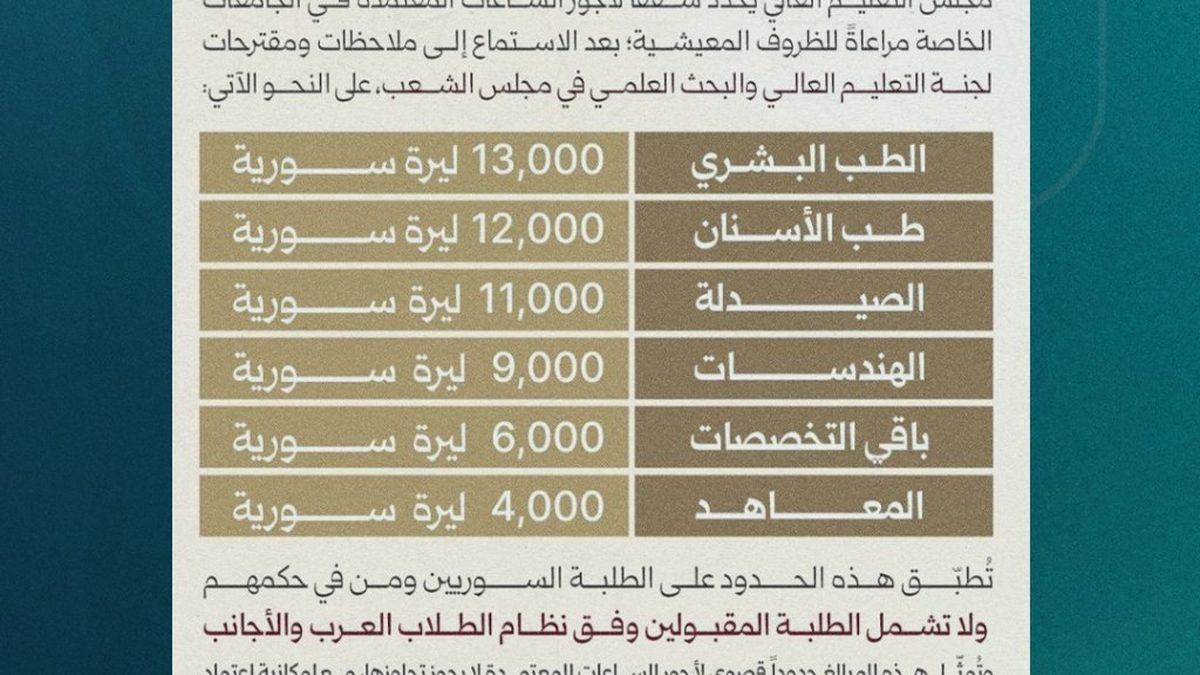
Syria's Ministry of Higher Education and Scientific Research announced that the Higher Education Council has set a ceiling on credit hour fees at private universities. The decision came after reviewing remarks from the parliament's higher education committee.
This article is shown in English; SYPNow publishes its newsroom in Arabic and English only.
Key points
- Syria's Higher Education Council set a cap on private university credit hour fees.
- The decision followed input from parliament's higher education committee.
- The fee ceiling amount and effective date have not been announced.
- Credit hours determine tuition costs at Syrian private universities.
What is the new credit hour fee cap?
Syria's Ministry of Higher Education and Scientific Research announced that the Higher Education Council, the body responsible for shaping university education policy in Syria, has approved an upper limit on credit hour fees charged by private universities. The move followed a review of remarks and proposals from the Higher Education and Scientific Research Committee of the People's Assembly, Syria's parliament.
No statement has yet specified the monetary value of the cap or when it will take effect, details expected to be clarified through official ministry circulars in due course.
How do private universities charge by credit hour?
Private universities in Syria operate on a credit hour system: instead of a fixed annual tuition, students pay based on the number of credit hours they register for each semester. The per-hour rate varies widely between universities and fields of study, meaning the total cost of a degree can differ substantially from one institution to another.
A unified ceiling matters because it limits how high these rates can climb and gives students and their families a clearer picture of education costs before enrollment.
What does this mean for Syrian students and families?
For context, Syria's public universities have limited seats, so many Syrian families rely on private higher education. The fee cap aims to restrain rising tuition costs and prevent excessive pricing. Its real impact, however, will only become clear once the ceiling's value is announced and compared with current market rates.
Does the decision cover public universities?
According to the ministry's statement, the decision applies to private universities only. The announcement made no mention of changes to fees at public universities or their affiliated institutes. The Ministry of Higher Education and Scientific Research remains the official reference for any further details.
Frequently asked questions
What is the credit hour fee cap in Syrian private universities?
It is an upper limit set by Syria's Higher Education Council on what private universities can charge per credit hour. The exact fee ceiling amount and its effective date have not yet been announced.
Who issued the decision on private university fees in Syria?
The Higher Education Council issued the decision, announced by the Ministry of Higher Education and Scientific Research, after considering remarks and proposals from the Higher Education and Scientific Research Committee of the People's Assembly, Syria's parliament.
When will the credit hour fee cap take effect?
The ministry has not announced an implementation date. Official circulars are expected to specify the cap's value and when private universities must start applying it.
Does the fee cap apply to public universities in Syria?
Based on the ministry's statement, the decision applies only to private universities. There was no mention of any changes to fees at public universities or state institutes.
More news
Live buy, sell and mid rates, measured and published by SYPNow.
SYPNow reports news from the sources it names. Exchange rates quoted anywhere on this site come from SYPNow's own measurement, never from a third-party bulletin.